Wednesday, November 12, 2008

The Medium or the Message? Which Wins Out?

Shepard Smith and Ralph Nader going at it on FOX News

On election night, everyone was talking about Barack Obama. Even Ralph Nader popped by FOX News to respond to comments he had made earlier, asking whether Obama would be “Uncle Sam for the people of this country, or Uncle Tom for the giant corporations,” calling into question Obama’s supposed abandonment of thousands of working people in America. After playing the audio clip of Nader’s statements, Shephard Smith stared into the camera and dramatically uttered the challenge, “Really?” Nader defended his claims vigilantly and calmly, and started to get angry only when Smith claimed that he had been “reduced to irrelevant” and insignificant in his most recent presidential campaign. Nader called Smith a bully, explaining that he couldn’t see Smith and the plug could be pulled on him at any moment. Asked point-blank whether he regretted using the phrase “Uncle Tom,” Nader raised his eyebrow and definitively said “not at all.” He started to attempt to explain the historical significance of the term to Smith, who promptly cut him off and thanked him for his time. Liberal Values’ Ron Chusid has a comprehensive collection of reactions to the FOX News interview, but there are no dissenting voices painting FOX News as having viciously attacked Nader. Some comments posted on Chusid’s piece defend Nader and claim that he was right in what he was saying. I find that the most glaring omission here is the treatment of Nader by Smith – regardless of what he said, the interview seems to have been poised as a takedown and a move to discredit Nader completely (FOX even put up vote percentages during Nader’s speech, underlining Nader’s low tally). Nader did make some good points about being the way he was being interviewed, which seem especially relevant considering our examination of FOX News. It’s a shame that his incendiary attitude will stand in the way of a legitimate argument.

Monday, November 10, 2008

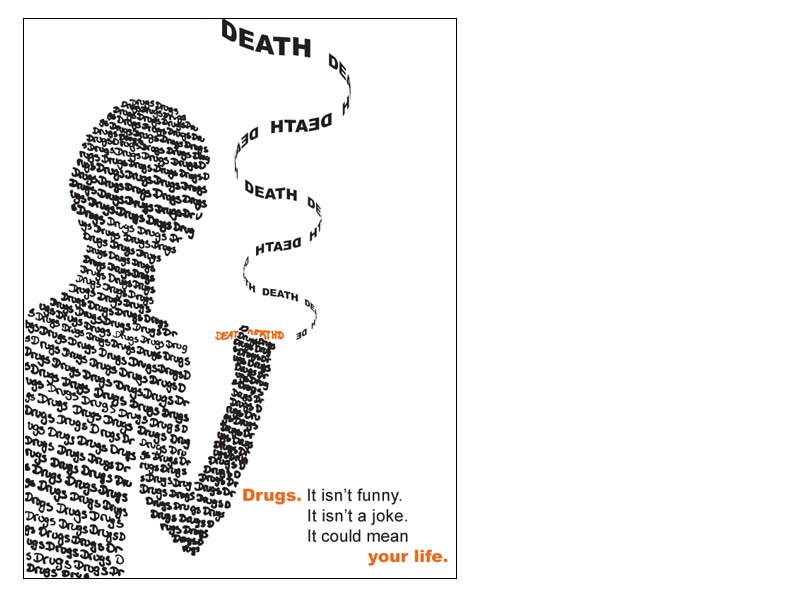
Drugs Kill... and cripple... and lead to HIV...and more

Anti-drug messages in the media are intended to scare rather than foster educated debate
Image courtesy of www.jessicacosta.com

The European Union is joining America in its anti-drug campaigning and preparing to launch its first drug awareness initiative. America's war on drugs, however, is hardly an ideal model. A new study shows that the billion dollar tax-payer-funded investment with heavy print and broadcast focus “failed to convince young children and teenagers to stay away from marijuana and actually might have encouraged some to try smoking pot.” The advertising led pre-teens to consider drugs as a ‘normal’ part of life. These messages also lead to a ‘forbidden fruit’ effect. Despite these charges, the National Youth Anti-Drug Media Campaign was quick to point out "drug use among teens has dropped steadily in nearly every category since 2001."

There is a difference between an informative campaign and blatant fear mongering. Associating drug use with STDs and graphic images (see freaky anti-drug commercial) not only confuses the message but closes the door to healthy debate. The Office of National Drug Control Policy created a series of video news releases – advertising disguised as prepackaged news stories, failing to explicitly identify themselves as the producers. This is nothing short of ‘covert propaganda’. These tactics are successful when used by car and lingerie advertisers. But they do not encourage a conversation with the viewer as a successful anti-drug campaign should.

The media has been happy to milk the anti-drug campaign for advertising dollars for the last ten years. As of 1998, the Magazine Publishers of America have agreed not only to run advertising but to support it with convincing editorials, blatantly admitting to excluding contradictory opinions. I was under the impression that journalists aimed to provide unbiased coverage of both sides of an issue, no matter how noble a cause may be.

Sunday, November 2, 2008

Old Media


Detail from Van Gogh's Old Man in Sorrow (On the Threshold of Eternity)


Print Journalism Beware: Christian Science Monitor, one of the nation’s oldest dailies will soon move from paper to web page; Time Inc. is laying off 600 employees; and Gannett plans to let go of 3,000 people, according to David Carr of the New York Times.

It’s as if the Wall Street virus has moved into newsrooms, only the public won’t react as powerfully to this crisis. After all, Joe the Plumber is a plumber, unlike Jorge the Journalist. It sounds more like this is the news industry’s business to figure out how to resolve the lost revenues in print media, not Joe’s. However, shouldn’t he be just as worried?


David Carr writes that it’s not just old media mongers who are concerned about the decline of major print outlets; He names Google’s CEO Eric Schmidt as one worried media expert who envisions major damage to the Web if the great dailies were to disappear. It would become a “cesspool of useless information.”


How else will smaller newsrooms affect Joe?


NPR’s Madeline Brand says, “There’s lots of news out there and now fewer people to cover it.”

For example, if Plumber Joe reads the L.A Times, he’ll only hear from the staff’s one movie reviewer. If he reads one of Gannett’s papers, he’ll be served news from “fewer reporters and editors overseeing the deeds and misdeeds of local government and businesses,” writes David Carr.

One “Editors’ Selection” comment (see No.8) following Carr’s article notes that online articles are read differently than printed articles.

An example of this might be Yahoo’s reporting of CSM’s new home on the web compared to Business Week’s article on the same issue.

Headlines in the Yahoo article highlight “Fully Embracing the Internet,” and “The Wave of the Future.” Business Week heads two sections of its article, “Layoffs Loom,” and “A Heftier Read.”

At the core, this sounds like a revenue/consumer issue for the news industry to resolve, but it wouldn’t hurt to have more reporting and deeper analysis on the new mutation of printed materials.


To release or not release the tape.


(Photo of Rashid Khalidi, courtesy of the LA Times)

In Fox's latest attempt to out the 'liberal media,' Sean Hannity, among others, are demanding that the LA Times release video footage of Barack Obama toasting Rashid Khalidi, the former head of the PLO in the late 70's, at a recent dinner (also in attendance: Billy Ayers). The Times has responded and since said that it will not release the tape. But how come?


The case isn't so simple or just about a tape in fact. The tape was acquired by the Times from an anonymous source and the story first went to print in April, over 6 months ago. The only mention of the tape in the story was: "The event was videotaped, and a copy of the tape was obtained by The Times" about 2/3rds of the way into the piece. Nothing about confidential sources. Nothing about what was said at the event.


We all learn during the early days of J-school, you never give up a source who requests that his/her identity be kept hidden. That's a given. But why not at least a manuscript, LA Times?


The media, in particular The LA Times, have drifted from that policy before. For example, the Times released a transcript in an article on Governor Arnold Schwarzenegger in 2006, during his bid for re-election in California. The governor was caught on tape speaking about Hispanics and the LA Times received the audio from an also unnamed source. They chose to run the transcript anyway.

Just a few days ago, The Times endorsed Barack Obama for president. Are they now able to deal fairly with potentially damaging information about the Democratic candidate?

While I understand the ethical grounds, the Times has already broken that deal before. Why not do the same here?

Air Obama Access Limited


Air Obama, from Flickr.com User Wavy1

According to Politico.com, Obama did a little bit of housekeeping aboard his campaign jet Air Obama on Thursday, revoking the seats of reporters from The New York Post, The Washington Times, and Dallas Morning News. Those papers also happened to endorse John McCain. Obama campaign won’t admit there is a connection.

In an email to The Washington Times, Obama’s communication chief Anita Dunn wrote:
"Demand for seats on the plane during this final weekend has far exceeded supply, and because of logistical issues we made the decision not to add a second plane. This means we've had to make hard and unpleasant for all concerned decisions about limiting some news organizations…"
Bill Burton, another Obama spokesman however, was a little more honest, explaining that the seats were reshuffled in an effort to reach as many swing voters as possible. Though I’m still convinced these papers lost access because of their endorsement of the enemy, Burton’s explanation reveals how the Obama campaign uses the press just like they use the campaign for news fodder.

Obama’s campaign (or anybody’s campaign, for that matter) doesn’t have to let the news media to tag along aboard their jet. While the media might fancy themselves educators of an electorate in an "election of a lifetime," they’re not reluctantly granted access to a campaign jet out of a respect for their role in democracy, but rather access is granted or rejected based on a new outlet’s ability to serve as an effective mouthpiece for the campaign. What we see here with this seat revoking business is the Obama campaign strategically adjusting the levels of his media "filter" (as conservatives like to call it) to "low risk."

In fact, come Saturday the same Politico article reports that all major news papers and foreign press (save for Agence France-Presse) are not welcome on Air Obama. Instead, only the most harmless media specimen (two documentarians and a few magazine writers) will take their place.

As the election winds down and Obama finds himself ahead, he needs nothing more from the news media and looks like he’ll discard them like a two-dollar-whore.

Cartoonist Under Fire


Part of Wednesday's future-forecasting strip, from the L.A. Times article discussed below.

Newspapers may have the right to make political predictions, but what about cartoonists? Purposely satirical and unabashedly liberal comic strips like “Doonesbury” might seem like they should have free reign on expressing political views. The concern here is that the accuracy of the strip’s prediction may be off, and that the 1,400 newspapers running the strip might be unfairly associated with the strip’s incorrectness. “Doonesbury” creator Garry Trudeau has already prepared a strip for Wednesday’s papers, in which Obama is celebrated as the victor of the presidential election. The L.A. Times reports the story, and John Robinson from The Editor’s Log takes a critical angle of attack. A commenter named Anne writes in response to Robinson’s post that any conservative who “get[s] all fired up and blame[s] the newspaper is just like a liberal Democrat tuning in to Fox News, getting angry and blaming the cable company. Change the fricking channel.” Trudeau himself responds in a Washington Post article, claiming that he chose the topic to be part of history, rather than write about something else. Why all the fuss over someone who is certainly more of a commentator than a reporter? Robinson emphasizes Trudeau’s obvious political leanings, and Trudeau notes that if his cartoon is inaccurate, it will hardly be noticed. The bigger issue is that Trudeau is hardly the only one predicting Obama to win on Tuesday, so why is his prediction taking center stage?

Who is the real Barack Hussein Obama Osama Obama?


I am not sure the Associative Property works this way.
(a screen shot from Brave New Films)


"I don't care so much what the papers say about me. My constituents can't read. But, damn it, they can see pictures!"
-Thomas Nast


Slate's Jack Shafer aptly quoted Mr. Nast in his look at the New Yorker's button pushing "Politics of Fear" cover. Painting Barack Hussein and Michelle Obama in all stereotypes that about this summer, Barry Blitt depicted the two in "standard terrorist" garb--you know, the turbans, the AK-47, the obligatory Osama Bin Laden portraite. It seemed like everyone had something to say when the issue hit the new stands. Some lauded the satire, heralding readers as sophisticated enough to understand the intended satire. Shafer, himself, wrote that "Only weak thinkers fear strong images."

Others, however, questioned the
New Yorker's taste, in inevitably the publics ability to discern fact from fiction. As Rachel Sklar of the Huffington Post posited, "This is going to upset a lot of people, probably for the same reason it's going to delight a lot of other people, namely those on the right."

With all hurtful/illegitamate stereotypes (Barak as a Muslim, Michelle as Angry, both as radical and unpatriotic...) rolled into one cover, it seemed to become unclear to readers and pundits alike where the joke lie: in a satire of the man or the rumors surrounding him. The critical looks from all sides made it clear that how something appeared carried as much heft as what something actually said. Satire or not, people weren't sure and
not everybody seemed to trust the public to figure it out.

This past weekend,
Glenn Greenwald of Salon feared that confusion was abound once more in claiming that "One of the few things worse than right-wing pundits trying to depict Barack Obama as a Muslim in order to win the election are the ones who do it but then are too cowardly to admit they're doing it." Mark Steyn of the National Review called the media a band of "eunuchs in Sultan Barack's harem" on both the pages of the Review and on The Hugh Hewitt Show.

While not calling Obama a Muslim outright, and certainly not branding him "Terrorist," Greenwald decries such analogies as "pathetically desperate." And neither Steyn's remarks nor the
New Yorker cover were the first to draw the tie between "Obama" and "Muslim."

So again, the question is raised: can the American public look past the visual and rhetorical laden narratives of the media? Or will the satire and word play muddle their understanding of what's really being said?

These questions leave me especially fearful in light of some recent Obama endorsements. Last week,
Amir Taheri penned "Obama and the Arabs: Why Muslims See Him As One of Them" for the New York Post. Taheri drags the question to the foreground in insinuating, quite dubiously, that "While Obama has tried to push his origins into the background, his 'Islamic roots' have won him a place in many Arabs' hearts." He goes on to find that "pan-Arab nationalists angry with the United States," Palestinian radicals and gasp! liberals, alike, are hopeful in his ability to create the radical changes they are hoping for.

The kicker? According to
reliable Taheri, some Arab commentators know better than to believe all they are given and counsel readers to tread with caution. "Every American president would be governed by American interests. Obama's understanding of politics is not important here," he quotes Tareq Al-Houmayed of the daily Asharq Alawsat. After his laundry list of Arab's for Obama, he goes on to demonize the Arab world in pitting what's important "here" against what's important "there." So when he claims that "Muslims see him as one one of them," it can't be a good thing, right?

Muslim or Not is no longer the question. I can only hope that the critics who spoke so passionately against the
New Yorker's cover weren't right, and that the American people can disentangle lose connections to find stronger truths. As things stand, it seems power is in how confused the media can render the reader. Admitedly, the New Yorker adamantly declared their cover satire, but Steyn and Taheri and the Post's intentions can only be assumed.  Yet, something seems fishy.  After all, in the end, what seems to be is not exactly what is, and there seems to be power in the ability to confuse the two.